
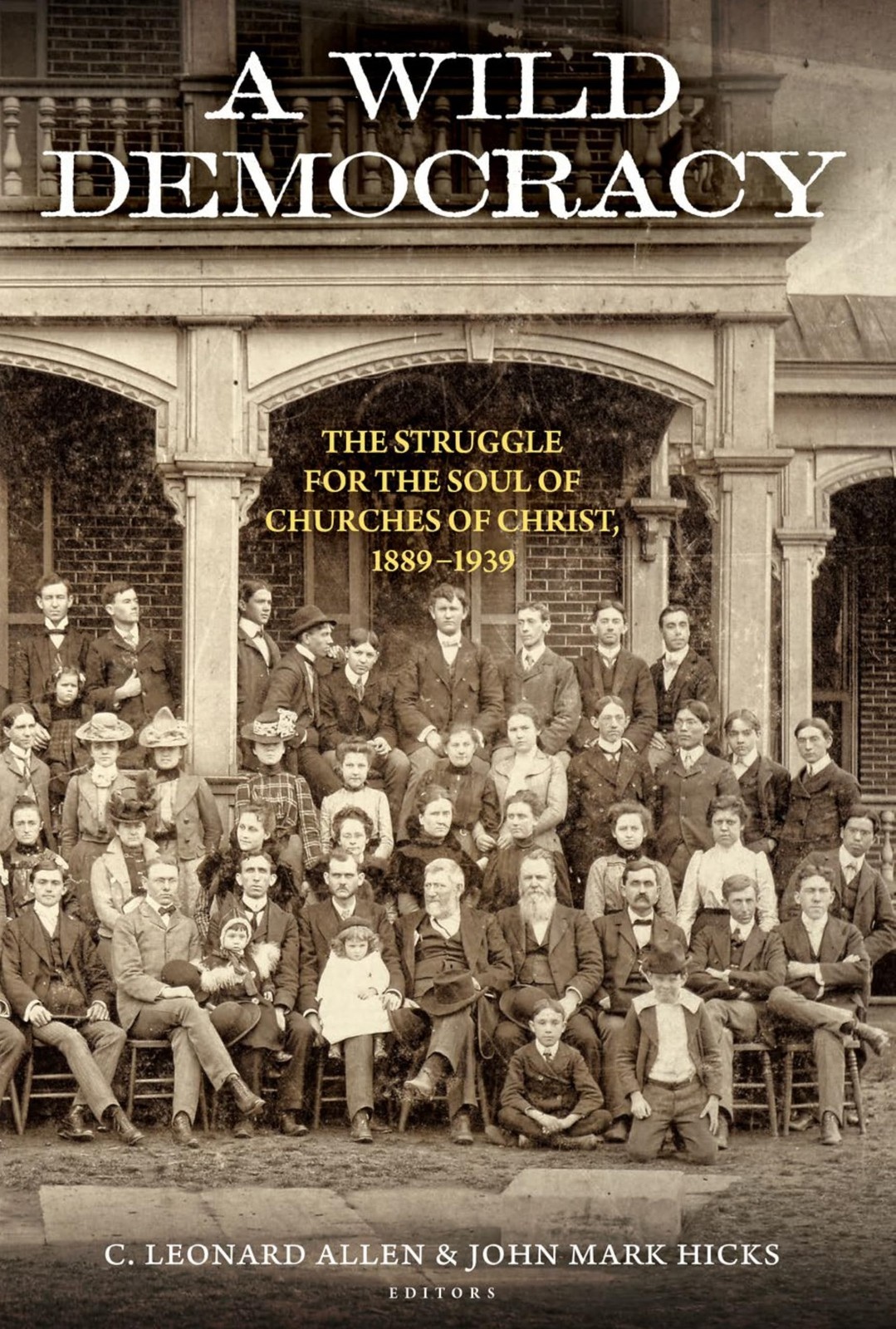
A Wild Democracy: The Struggle for the Soul of Churches of Christ, 1889-1939 (Volume I of “Churches of Christ in the Twentieth Century”); edited by C. Leonard Allen and John Mark Hicks; Abilene Christian University Press, Abilene, Texas (www.acupressbooks.com); trade paperback, 192 pages, $19.99; copyright 2026.
A Wild Democracy is a church history that was long overdue. I’d call it an “evaluation” or an “assessment” more than a history. Therein lies its value. In its fresh perspective, it does more than just trace landmark steps in the historical trajectory of the Church of Christ. Instead, it dives deep into the doctrinal contests that drove the changes within the brotherhood. More than just identifying disputes and controversies, A Wild Democracy orders them into a framework that illuminates the struggle as perhaps it has never been revealed before. This book’s examination of the church’s progress as a tension between three traditions—The Tennessee Tradition, The Texas Tradition, and the Indiana Tradition—is perhaps the biggest contribution that A Wild Democracy makes to Church of Christ (and Restoration Movement) literature.
I’d seen talk along these lines before, and for me that was in online posts by co-editor Hicks and contributor Bobby Valentine, both of whom were fleshing out the Texas-Tennessee-Indiana positions as recently as a few years ago. In the book, Hicks writes, “In general… Tennessee embraced dynamic divine action in the world identified as the in-breaking of the kingdom of God; Indiana stressed the non-institutional and otherworldly character of that kingdom; and Texas emphasized a high view of human rationality that often focused on human mechanics and obedience.”
View in Store
hat might be equally instructive in examining these traditions is the way the authors have identified not just the leading lights of each, but have placed them in their respective camps, showing their respective affinities. Instead of seeing isolated fights, we see where the various players land on the broad spectrum of church opinion, and how they stand in opposition to one another as groups, and not merely as individuals. I’m not saying it’s pretty, but I’m saying the politics become clearer. It’s a less-than-happy thought to be using a word like “politics” here, but there truly is a Left and a Right to this conversation, and in grasping where the thought leaders fall on a continuum, we begin to see the deeper undercurrents, and the stakes as well. That’s what the Texas/Tennessee/Indiana demarcations accomplish.
What we’re seeing here, too, is how believers behave when they find themselves in a movement (Restoration Movement) wherein members are not controlled by a denominational government or hierarchy. And the answer is, they behave as a “wild democracy.” At least that’s true during some part of their progress. Yet why would that not be true? To be freed from a governing council or body means Christians have some say in their own fellowship’s positions, directions, and beliefs. Having choices means enduring dissent. This movement ushered in a theological and ecclesiastical free-for-all.
Let’s say a person is forced to live with a certain messiness and even strife within the rank and file of a membership. That seems, to our current sensibilities, deplorable, right? But if those issues were instead kicked upstairs to a ruling council, would there not still be a messiness and infighting going on? Only in that case it might be going on in closed chambers. Which is better—open discussion among all or closed, private decision-making?
But our topic was regional traditions. For the Tennessee Tradition, the main voices (in the early going) were Tolbert Fanning, David Lipscomb, and James A. Harding. The Texas Tradition was characterized by such figures as Austin McGary, J.D. Tant, R.L. Whiteside, Foy Wallace, Jr., C.R. Nichol, and G.H.P. Showalter, among others. The Indiana Tradition found its main voices in Benjamin Franklin (1812-1878)—the Restoration preacher, not the Colonial era statesman—and Daniel Sommer, a figure who deserves more attention than past writers have given him. Later, Carl Ketcherside would lend his voice to this cause.
The Tennessee Tradition strongly influenced Southern Churches of Christ, while the Indiana Tradition was felt most in the Northeast and especially the Upper Midwest of Ohio, Indiana, Illinois, etc. The Texas Tradition dominated Texas, of course, and parts further west and north. The Tennessee Tradition held sway in the Nashville Bible School and at the Nashville-based publication known as the Gospel Advocate. The Texas Tradition had for its sounding board Austin McGary’s Firm Foundation publication, founded in 1884 as a reaction to the then-growing influence of the Gospel Advocate in Texas. In early issues of the Firm Foundation, one finds, as Hicks notes, “a different spirit…. The personal indwelling and enabling power of the Spirit is denied, special providence is rejected, and ‘exact obedience’ to ‘positive commands’ is emphasized.”
The Tennessee Tradition strongly influenced Southern Churches of Christ, while the Indiana Tradition was felt most in the Northeast and especially the Upper Midwest of Ohio, Indiana, Illinois, etc. The Texas Tradition dominated Texas, of course, and parts further west and north. The Tennessee Tradition held sway in the Nashville Bible School and at the Nashville-based publication known as the Gospel Advocate. The Texas Tradition had for its sounding board Austin McGary’s Firm Foundation publication, founded in 1884 as a reaction to the then-growing influence of the Gospel Advocate in Texas. In early issues of the Firm Foundation, one finds, as Hicks notes, “a different spirit…. The personal indwelling and enabling power of the Spirit is denied, special providence is rejected, and ‘exact obedience’ to ‘positive commands’ is emphasized.”
By 1939, the concluding year of this book’s chosen timeframe, the Tennessee Tradition was losing influence and the Texas Tradition was in ascendancy. Hicks writes, “Rebaptism became the majority position. Millennialism was driven out. The personal indwelling of the Holy Spirit became a minority view. [Emphasis mine. —JFM] Many ridiculed special providence.”
One tendency found within some circles of church membership that I did not see discussed is a characteristic I would call “anti-intellectualism,” and by that I mean a hostility to learnedness, especially academic learnedness as it finds expression in theology. Somehow, the “Just the Bible” mentality fosters in some a resistance to scholarliness. Why this should be so I cannot understand. To me, the Restoration Movement itself is/was a great intellectual achievement—in addition to its profound spiritual impact—and a source of enlightenment and moral uplift not just within Christian circles but within the wider world as well, in the sense that a rising tide “lifts all boats.”
When the Restoration Movement took root in the United States in the early 19th Century, it was hailed as a unity movement, and differences of opinion on doctrine and church practice were shown considerable tolerance, given the overarching desire to extend fellowship, one body to another. This tendency marked the first 80 or more years of the movement, as variant names (Disciples of Christ, Church of Christ, Christian Church) were treated as meaning little to nothing. A member of one felt himself to be in fellowship with a member of another. All of that changed with time, of course.
Contributor Nathan Guy provided a chapter on evangelist T.B. Larimore (“Following No Faction”) that posed a nice contrast to the contention discussed elsewhere in the book. Larimore, described as “deeply loved and admired by all who knew him,” is held up as an example of a minister who “preached all over the country and, in the midst of a deeply divisive period, offered a non-combative, non-separatist ‘third way’ for Christian identity and fellowship.” Guy shares this passage: “’The thought of’ wrangling over matters of dispute ‘is revolting to me’ wrote Larimore. ‘To do good, I must love my brethren, and never refuse to fellowship them—ANY OF THEM—simply because we do not always understand all questions exactly alike.’” He adds: Larimore “maintained… friendships with Christians on every side of Christian divides [and] willingly preached for churches that differed from one another on contentious issues.”
I found this perspective to be in harmony with that old Restorationist motto most of us have heard: “In matters of faith, unity; in matters of opinion, liberty; in all things, love.”
My own view, having read this book, is that the early Restorationists were reluctant to draw lines on doctrine or interpretation and were anxious to accept Christians on simple terms: belief in the Bible as God’s Word and rejection of human creeds. Beyond that, it appears, there was little that posed grounds for disunity. But the later generation(s) of Restorationists proved to be intolerant on matters of opinion. “Wrong” doctrine became grounds for disunity.
Let me stop and give a definition of “doctrine.” My definition, anyway. While many simply equate the word with “teaching”—i.e., the teaching that we find in the Bible—I’m going further in saying that doctrine is in some sense interpretive or exegetical. I’m saying that the teaching or the message that we take away from the Bible has something of ourselves in it. It is our own particular interpretation of what the text says. There needs to be a distinction. There is the text itself. And then there is whatever we make of the text. The latter is what I am referring to as doctrine, and one’s doctrine could very well be exactly what the text says, but history shows that that is hard to prove to everyone’s satisfaction. So the text is one thing, and what I derive from the text is possibly the same and possibly not, and what I or others derive is what I call “doctrine.”
There is the doctrine of baptism, of justification, of sanctification, of atonement. There are doctrines of kingdom, work of the Spirit, discipleship, grace, salvation, revelation, millennialism, and eternal life. And on and on. When we blend a selection of texts into a broader understanding of what the Bible is saying on a theme, what we have is a doctrine, which is a human view of what the text says. Doctrines are not the text. They are our understandings of the text.
This distinction makes me wonder if doctrine ever ought be a test of unity. And yet have we not heard that it is? Have we not somewhere heard someone say, “There’s no unity without doctrinal unity”? Such a position cannot but lead to splits.
In some congregations today, what I’ve noticed leadership doing, when it encounters what it considers too much waywardness in viewpoints or in teaching, is to head off such opinions “to preserve unity.” I’ve seen a teacher quote from the writings of a non-Church of Christ figure during a lesson and later be instructed by a church leader not to quote from that source again. I’ve seen another teacher raise the idea that the indwelling of the Holy Spirit could be from the Word only and not from the act of baptism and later be told not to bring that idea up again.
Do you see what has happened in this instances? Unity has quietly been redefined as doctrinal conformity. Whether the doctrines (let’s call them the opinions) are those of the many or just the few, they are in any instance the conclusions of mere humans. Is it a stretch to think of those doctrinal conclusions as human creeds?
In contrast to the wild democracy of 1889-1939, there is the milder Church of Christ of today, wherein the stridency and disputing of the past has been all but silenced. That development would seem, from all appearances, to have been received as an unmixed blessing. I know as well as anyone that the ugliness that accompanied some of the debating of the 19th and 20th centuries was disgraceful. It seems, however, that the cure for badly handled debating became the avoidance of debating. The controversies were not settled. They were simply abandoned, unresolved. Further, for anyone to revive the topics of those debates, even politely, is for that person to risk criticism or censure. Many important doctrinal questions are now all but off-limits for discussion, because we have “moved on from that divisiveness,” closing the doors to examination of the text, discussion, and deeper spiritual growth.
But let me share, as a point in contrast, one example of how things were handled in the past. This is from a debate, but not an ugly debate. (Not all debates were conducted in a reprehensible fashion, though that’s how the debating of the past is remembered today—as mean-spirited and lamentable, categorically. Some debates, maybe even most of them, were honest presentations of two competing views of the meaning of the text. These debaters potentially gifted their hearers and readers with opportunities to draw conclusions from their well prepared textual arguments.)
In his 2019 biography of preacher Gus Nichols (1892-1975), author Scott Harp describes some exchanges decades ago at the Freed-Hardeman Lectures held annually. Nichols would debate evangelist Guy N. Woods on the topic of the Holy Spirit. Woods (1908-1993) held that the Spirit dwells in the Christian “through the Word only,” (again, that view) while Nichols maintained that the Spirit indwells the Christian personally and bodily “in a manner distinct from the Word.” Wrote Harp: “Sometimes the discussion took up the better part of the hour. However, they always demonstrated a sense of respect and genuine love for each other, stating that some things in the Bible can be disagreed upon and fellowship continue to be maintained.”
I ask—how many congregations today will even permit such a conversation to take place freely, in a church class setting? The question of the bodily, personal indwelling of the Holy Spirit—received at baptism—is either assumed as a given or the conversation is swiftly curbed, at least from my own observations.
When the thornier questions posed by the text can be steered away from by congregational leaderships anxious to “avoid divisiveness,” that leadership is able to “have things both ways,” as the saying goes. First, they dispense with the difficult conversations. And second (and less obvious) is that one interpretation of the “troublesome” text has survived as the status quo interpretation of that text. You see, it’s never that we have NO interpretation of a text. But it’s sometimes the case that we live with one interpretation and no other is allowed. So, in one sense, curtailment of debating effectively freezes the discussion, leaving in place a surviving “winning” interpretation that is now not to be questioned, at least not in congregational settings.
But the example of Nichols and Woods shows that such questions can be examined in the light of day and need not be accompanied by acrimony or avoidance.
I’m persuaded, from the example of T.B. Larimore, that the right response to any holder of a divergent opinion should not be that that person be stifled or stigmatized, much less disfellowshipped, but that such encounters be handled with examination of the scriptures and by reasoning together. (If ever someone is to be disfellowshipped, it ought to be for sin, not for an opinion.) If some Christians find a variant opinion to be challengeable, that opinion could be tested, not denounced. If the Bible holds the truth, then the Bible is the arbiter of arguments. If the body is composed of earnest Bible students, there should hardly be fears that a variant opinion will necessarily corrupt or consume the body.
Besides, if a majority agree with a teaching, even if it was formerly a dissenting, minority view, who is to say it now has no place in the assembly? And if a dissenting view does not convince the majority—if most local members disbelieve in it—what is the harm in it persisting locally, as an acknowledged minority view? Posing a unified front to the world—which is in essence a doctrinal or creedal front—that is the stance of a denomination, not a fellowship of mere Christ-following disciples. And if indeed we are wrong to perceive unity as coming only from conformity to shared doctrinal interpretations, then what ought we make of that? Is having shared interpretations the same thing as having only the Bible as our guide? We have to stop and remember that the text is one thing and our views on the text are not exactly the same thing. It’s easy to assume that they are.
In fairness, what I’ve said just above on unity is not from the book per se, but from my own thoughts after reading it. My case here is for a diversity of opinion, and a tolerance for dissenting views. That’s where strength lies, not in suppression.
Another virtue I found in this book was that it provides a nomenclature for discussing issues. Texas vs. Tennessee. Divine dynamic. The Man vs. the Plan. The Direct Operation of the Holy Spirit. Special Providence. There are others, not raised by the book: The Two Laws of Pardon. Cessationism. And the like. For the most part, these controversies were never settled conclusively. They have simply been stifled in the name of maintaining unity. The Wild Democracy has been tamed, and part of the cost was the disparagement of dissent.
I’m sure the authors each have their strong sympathies and antipathies. Nonetheless, I was greatly impressed by the restraint shown in discussing various viewpoints and the fairness of the treatment. Allen’s early chapter on “Entering the Story” is a succinct, revealing, even-handed accounting of the relevant events of the century leading up to the century the book examines.
The authors have framed the conversation we all should have been having. Besides those writers already mentioned, A Wild Democracy features a chapter each from Chris Cotten, Shelley L. Jacobs, Edward J. Robinson, and Steve Wolfgang. I’m impressed with the candor and honesty. The table is set for the forthcoming Volume 2 in this trilogy, and I for one will be looking forward to it.